Everybody knows comebacks don't work. Nobody has actually checked.
Unretirement is one of the oldest stories in sports and one of the least examined. The obvious way to measure it answers a different question than the one being asked.
By Parker · September 1, 2026 · 7 min read
Every few months a recently retired athlete announces he is coming back, and the replies write themselves. He should have stayed retired. It never works. Nobody comes back.
It is one of the most confident things fans say, and one of the least tested. We went looking for the study that settles it and could not find one. Not because nobody cares, but because the question is harder to ask than it looks.
First, the premise is wrong
Unretirement is not rare. It is not new, and it is not a modern branding stunt. It is a permanent feature of professional sport, and it runs on four separate engines that have almost nothing to do with each other.
Retirement is rarely binding. In most leagues nothing stops a player from filing papers and changing his mind. In the NFL it is actively useful: a player who retires under contract has his rights retained by his team, so he cannot simply sign elsewhere. That turns retirement into a negotiating position. When a 30-year-old with two years left walks away in March and resurfaces in October, that is usually a contract dispute wearing a costume.
The Olympics run on a four-year clock. Swimmers, gymnasts and sprinters retire after a Games and get pulled back as the next one approaches. Michael Phelps retired after London and won five golds in Rio. The cycle manufactures comebacks on a schedule.
Combat sports never really treat it as final. George Foreman retired in 1977, came back a decade later, and won a heavyweight title in 1994 at 45 years old. Georges St-Pierre stepped away in 2013 and returned in 2017 to win a title in a heavier division. In boxing and MMA the comeback is closer to the default than the exception.
And some of it is just boredom. Michael Jordan did it twice. Mario Lemieux retired, entered the Hall of Fame, bought the team, and then activated himself as a player. Brett Favre did it three times. Tom Brady's 2022 retirement lasted forty days.
Four different phenomena, one word. That is the first problem.
The second problem is the one that matters
Here is the comparison everyone makes without noticing. They measure the comeback season against the player's best season. Foreman at 45 against Foreman at 24. Jordan with the Wizards against Jordan with the Bulls.
That comparison cannot answer the question, because it has two things moving at once.
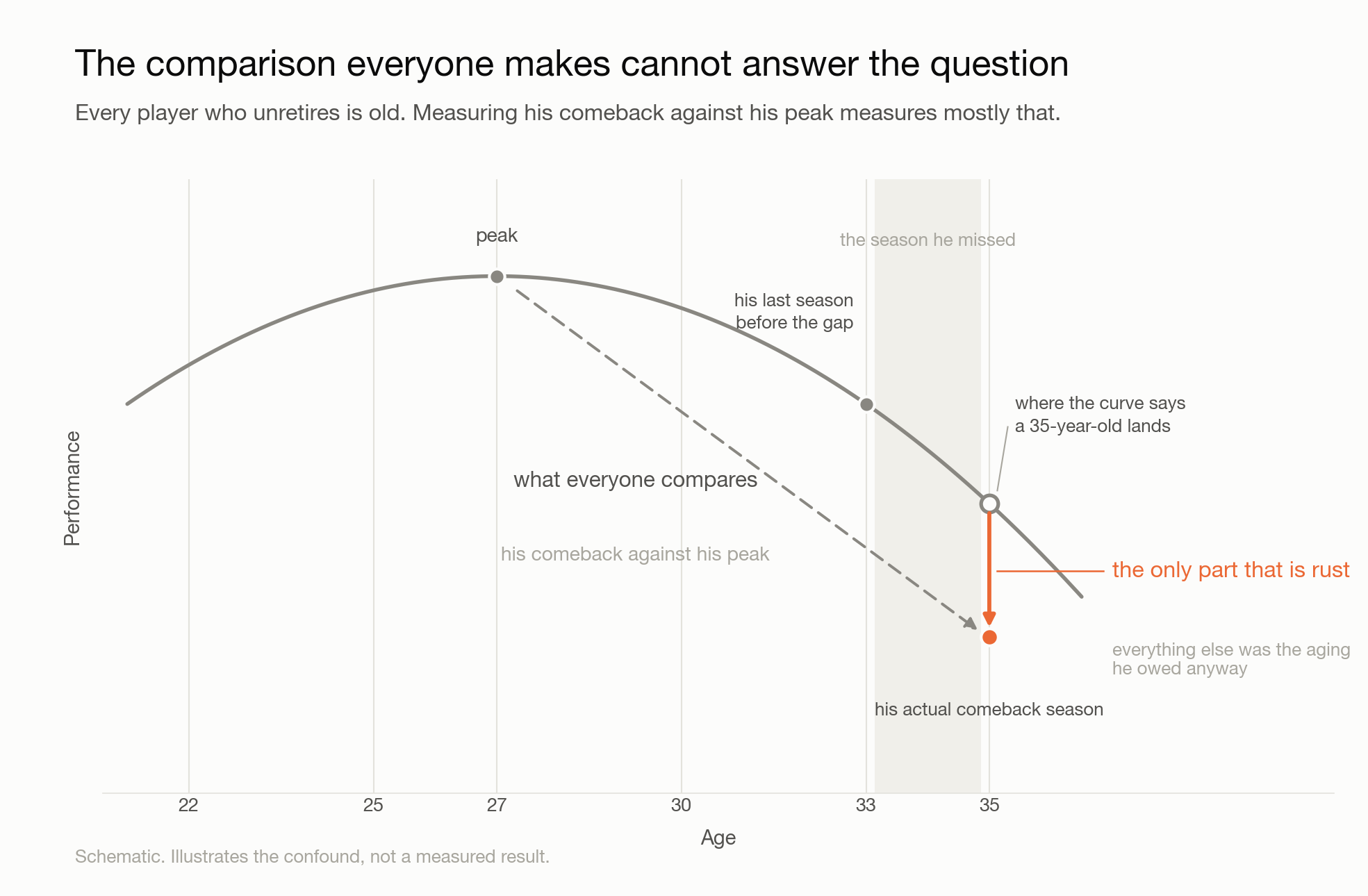
Everybody who unretires is old. That is not a coincidence, it is close to a definition. Players do not retire at 24 and return at 26. They retire at 33, sit a year, and come back at 35. So when a comeback season looks worse than a peak season, we have learned almost nothing. A 35-year-old would have been worse than his 28-year-old self whether he took the year off or not. Aging alone predicts the decline.
The question people actually mean to ask is narrower and much more interesting:
Does the year away cost anything beyond the year of age you were going to lose anyway?
That is a question about rust specifically, not about aging. Answering it requires something the highlight-reel version never supplies: a control group. Take the players who came back at 35 after a year out, and compare them not to their own younger selves but to players who arrived at 35 having played straight through. Same age, same career stage, different path.
Until somebody runs that comparison, "comebacks do not work" is a statement about the aging curve that has been mislabeled as a statement about time off.
Why the study is hard to run
We looked at what it would take. Three obstacles, in increasing order of nastiness.
Retirement is not a recorded event. No major stats database has a field for it. There is no row that says this player retired on this date. You have to infer it from absence: a player appears in the data, vanishes for a full season, reappears. That inference is doable, and across the NBA, NFL, MLB and NHL it produces a real sample, in the high hundreds, of players who played meaningfully, missed an entire season, and returned.
But absence is ambiguous. A player missing a full season might have retired. He might also have torn an ACL, or had Tommy John surgery, or been suspended, or gone somewhere the league's own data cannot see him. A one-season gap in the NFL is more often a knee than a decision. Without injury records reaching back through the whole period, the retirement cohort and the injury cohort are the same rows, and the finding is mush.
And the clean cases are the rare ones. Restrict to multi-year absences, where injury is a much less likely explanation, and the sample thins out fast. There are not many Foremans. The cases that most clearly isolate what we want to measure are the ones there are fewest of.
None of these is fatal. All three are why the piece you have read about comebacks was built from anecdotes instead.
What we would actually believe
Three findings would each be worth knowing, and we do not know which one is true.
If time off costs something real beyond aging, that is rust, and it should be quantifiable in games and in production. If it costs nothing, then comebacks look bad purely because of who attempts them, and the conventional wisdom is a selection effect that everyone has been reading as a causal one. And if it splits, by position or by role or by how much of the game was built on speed, then the interesting answer is which players a year off actually harms.
Our instinct, for what it is worth, is the second one. But an instinct is not a finding, and we are not going to dress one up as the other.
The part worth holding onto
The famous comebacks are famous because they are exceptions. Foreman winning a title at 45, Kim Clijsters returning from two years away and winning the US Open, Lemieux stepping out of the Hall of Fame and back onto the ice. These get cited constantly precisely because they are strange.
But the counter-examples are selected the same way. Björn Borg's 1991 return with a wooden racket, in which he did not win a match, is memorable for the same reason. Nobody keeps a list of the players who came back at 34, played 60 useful games, and were entirely unremarkable, because that is not a story.
Both lists are highlight reels. Neither is evidence. And the market that prices comeback players has been reading from them for as long as there have been markets.
Method note: this piece deliberately makes no quantitative claim about comeback performance, because the controlled comparison it describes has not been run. The gap-case counts referenced are candidate cases identified from season-level participation records across the NBA, NFL, MLB and NHL, not estimates of any effect. When the control group is built we will publish the number and show the work, including the version where we are wrong.
← Back to all posts