The NBA publishes a power ranking every August and hides it in the Christmas schedule
Eighteen years of Christmas Day slates matched against how each season ended: a real forecast with one famous blind spot, a rule about who gets dropped, and the longest bet the league ever made finally paying out at the Garden.
By Parker · August 12, 2026 · 8 min read
On Christmas Day 2025, the Knicks beat the Cavaliers 126-124 at the Garden. At the time it was a fun two-point holiday win over a conference rival. Six months later it read like a table of contents: New York swept those same Cavaliers in the conference finals on the way to their first title since 1973. The other marquee game that afternoon, San Antonio handling Oklahoma City by fifteen, previewed the Western final too, a series the Spurs won in seven. Both conference finals were settled on Christmas before they were ever played in May.
That's less of a coincidence than it sounds, because the Christmas slate isn't really a set of basketball games. It's a forecast. The league and its broadcast partners pick the five games in August, before a single possession has been played, and they're trying to guess which ten teams will matter in June. Which means every Christmas schedule is a power ranking the NBA publishes about itself, and it has a track record you can check.
So we checked it: eighteen seasons of Christmas slates, 2008-09 through 2025-26, matched against how each of those 180 invitations actually ended.
The August oracle has a real track record
15 of the last 18 NBA champions appeared on that season's Christmas slate, a slate set in August, months before opening night.
Ten Christmas teams out of thirty each year means the slate should "catch" a third of everything by luck alone. It does much better than that, and the deeper into the playoffs you go, the sharper it gets.
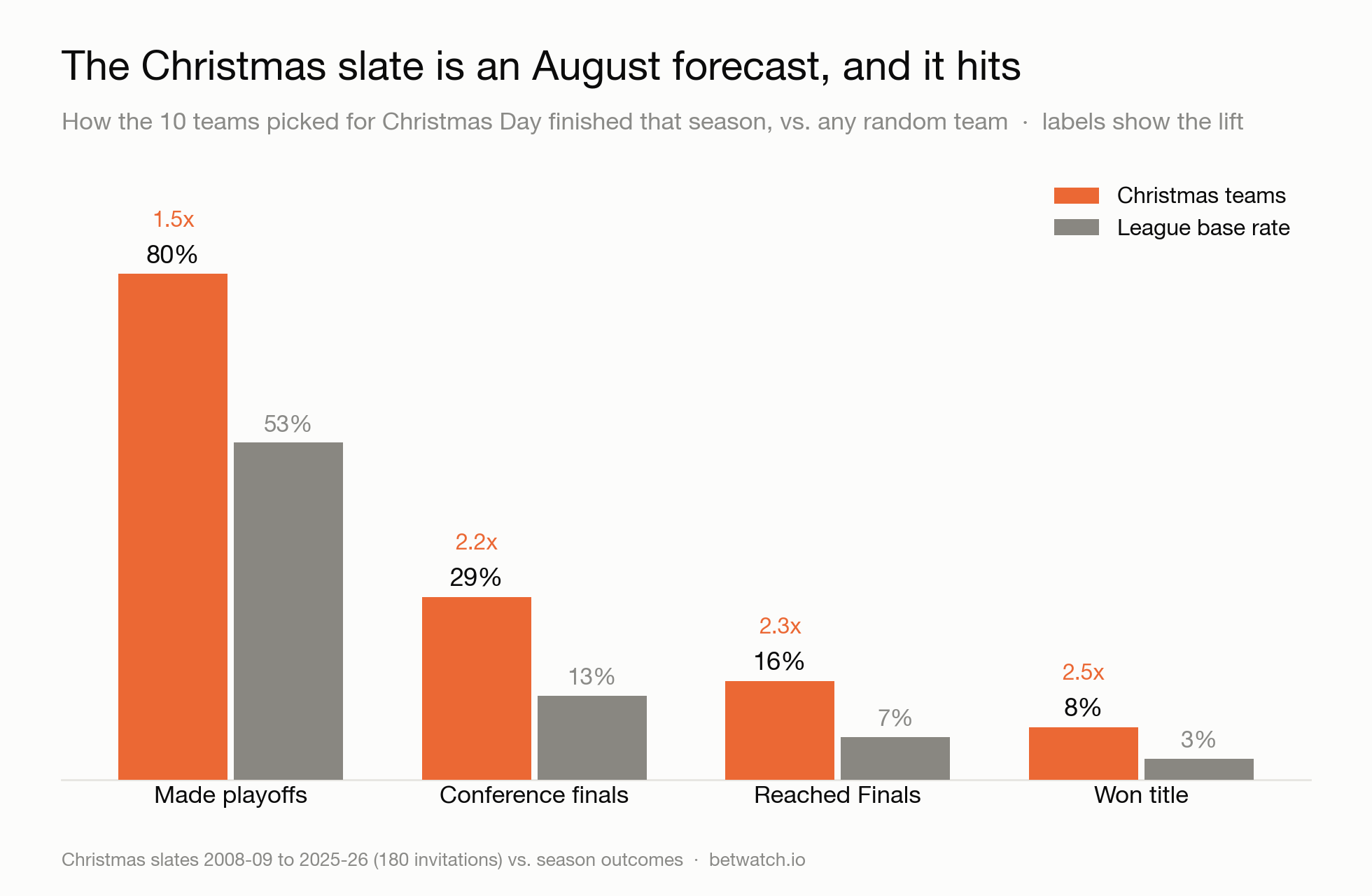
A Christmas invitation makes a team two and a half times more likely than average to win the championship. The schedule-makers, working in August with nothing but rosters and vibes, are genuinely good at this.
But the signal isn't evenly distributed across the ten seats at the table. To see where it actually lives, you have to ask why each team got invited.
Three kinds of Christmas invitations
Sort every invitation into three buckets. Fresh picks are teams new to the slate, or brought back after a gap. That's the league's bet on a rising storyline. Earned incumbents are teams on their third-straight Christmas or more who made the conference finals the season before, the dynasty track. And tenured seats are teams on their third-straight appearance or more without a recent deep run: teams that are there because they're always there.
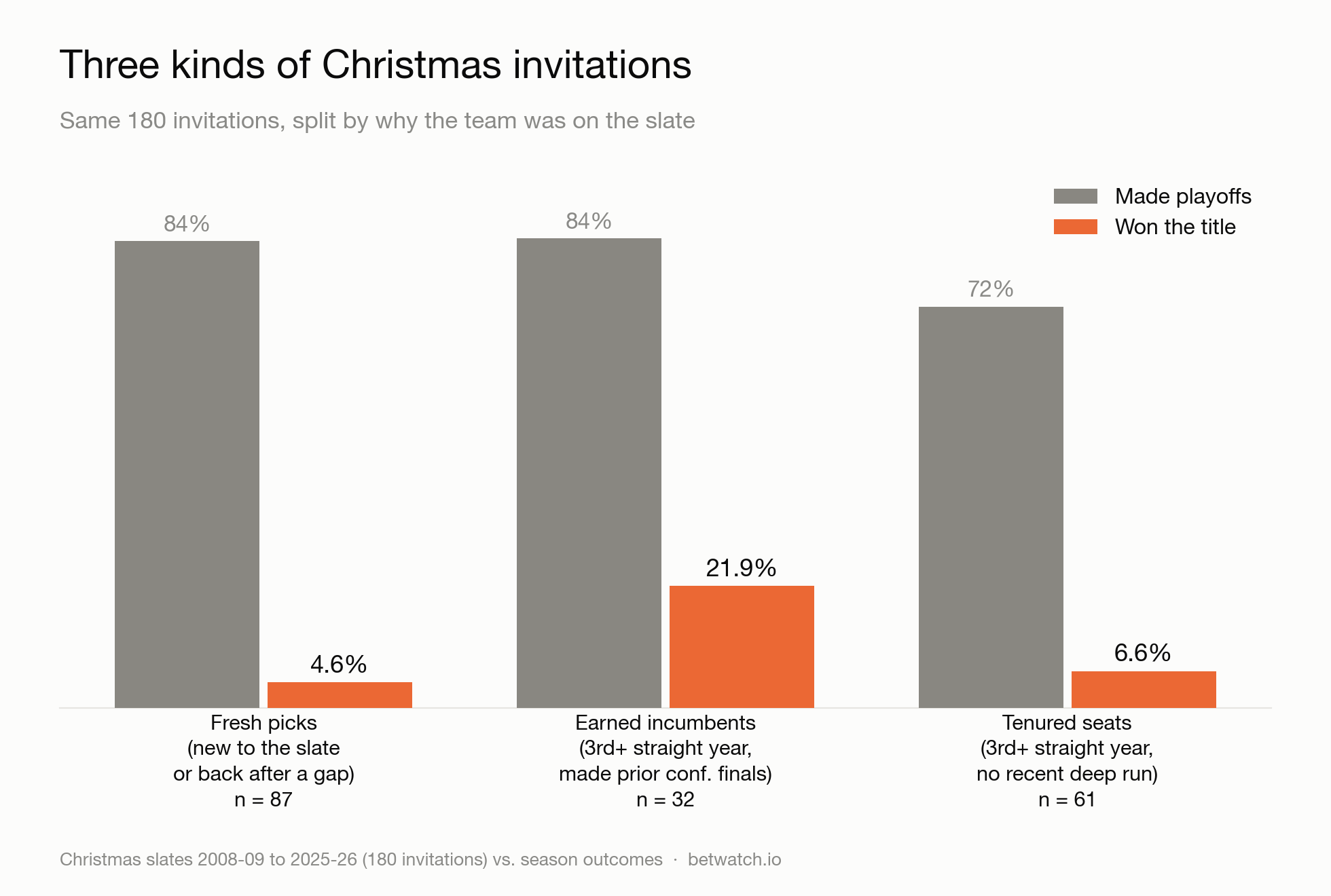
Read the orange bars first. Fresh picks are the safest playoff bet on the slate: when the league adds a new team to Christmas, that team almost always turns out to be real. But they almost never win it all the same season. The league's scouts spot risers a year or two before they're ready. Titles live almost entirely in the earned-incumbent column: teams that both held their seat and justified it.
Then look at the tenured seats. A full third of all Christmas invitations, 61 of 180, went to teams riding tenure rather than results, and that cohort barely beats a coin flip at making the playoffs at all. Twenty percent of all Christmas teams in the sample missed the postseason entirely.
Eighteen Christmases, graded
Here's the whole sample at once: every team invited to six or more Christmases, and how each invited season ended.
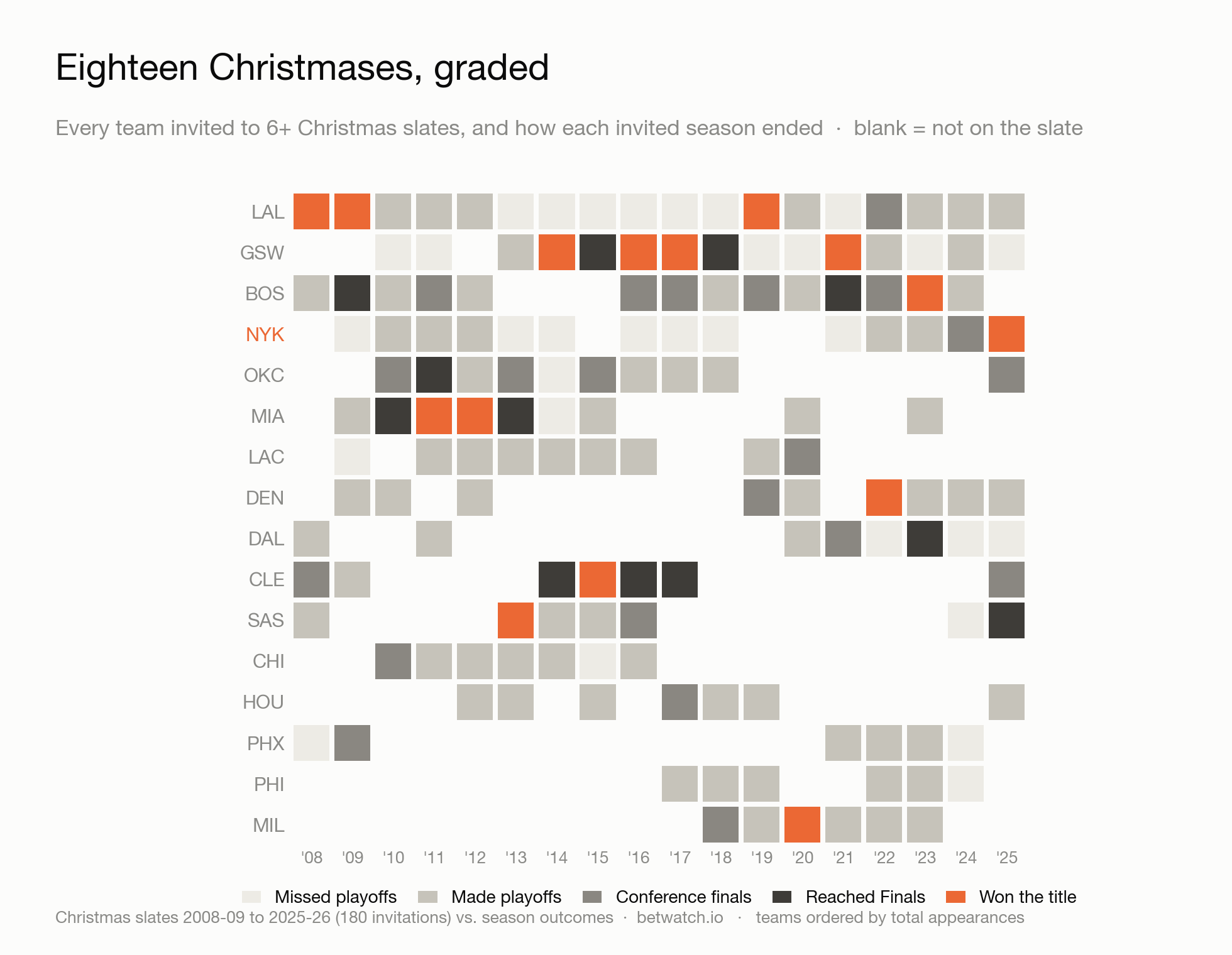
The Lakers are the only franchise on all eighteen slates, and they missed the playoffs in seven of those seasons, including six Christmases in a row from 2013 to 2018 when the invitation was purely a television decision. The Warriors' mid-decade run is what an earned seat looks like: five straight years ending in the Finals. And the Knicks row is the story we'll get to: a wall of invitations, very little to show for them, and then the last cell is orange.
The blind spot: the three champions Christmas missed
Only three champions in eighteen years were left off the slate: the 2010-11 Mavericks, the 2018-19 Raptors, and the 2024-25 Thunder. They're not random. All three were mid-market teams, and none of the three had made even the conference finals the season before. That's the one profile a ratings-driven forecast structurally cannot see: the team from a smaller market standing one step from breakout. When the schedule-makers miss, they always miss the same way.
Trust the drops more than the adds
There's one more place the slate hides information: who gets removed. Fourteen times in the sample, a team made the conference finals and was then left off the next season's Christmas schedule. Three of those fourteen marched back to the Finals anyway, but none of them won it. Zero for fourteen. Meanwhile, prior conference finalists the slate kept won the title 16.7% of the time.
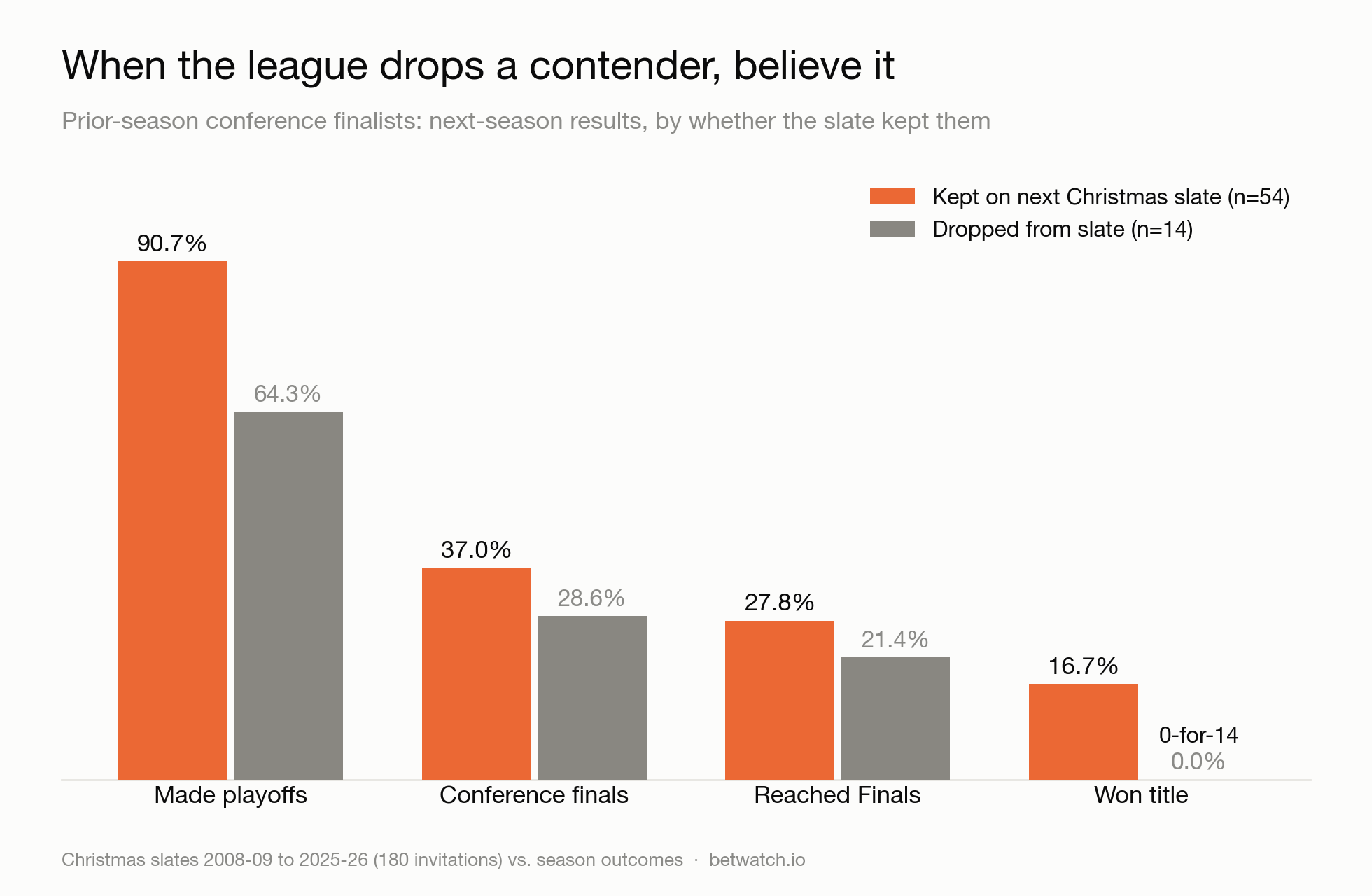
When the league quietly takes a proven team off the marquee, it's usually because it knows something: an aging core, a contract year gone wrong, a window that already shut. The slate's adds and drops are its sharpest opinions. The tenured seats are its dead weight.
The longest bet the league ever made
Which brings us to New York.
The Knicks appeared on fourteen of the eighteen Christmas slates in this sample, second only to the Lakers, and for most of that run the invitation had nothing to do with basketball. Their first Christmas of the era, 2009, they hosted Miami as a team that would finish 29-53. In seven of their fourteen Christmas seasons they missed the playoffs entirely. By our cohort math, nobody held more unearned Christmas real estate this side of Los Angeles. The Garden got the game because the Garden gets the game.
And then, slowly, the seat stopped being a gift. The 2024-25 Knicks made the conference finals, a genuine deep run and their first of the sample. The slate kept them, as it keeps all proven contenders, and in 2025-26 they did the thing eighteen years of Christmas invitations had been predicting: won the East, beat the Spurs in five, Jalen Brunson closing it with a Finals-record 45 points in Game 5, first banner since 1973. They came from double digits down in all four of their Finals wins, which is somehow the most Knicks way imaginable to finally be as good as advertised.
So no, the punchline isn't that the league kept inviting a bad team to Christmas dinner. The punchline is that the league's longest-running, least-defensible forecast eventually became its most vindicated one. The NBA wasn't wrong about the Knicks. It was seventeen years early.
Reading this year's slate like the league does
The 2026-27 Christmas schedule is already out: Spurs at Knicks, a Finals rematch on the marquee, plus Heat-Celtics, Sixers-Lakers, Thunder-Timberwolves, and Nuggets-Warriors. Run it through the same three buckets and the slate is telling you plenty.
The earned seats: the Knicks, Spurs, and Thunder are all retained coming off conference-finals-or-better runs, the cohort where 22% of title equity has historically lived.
The tenured seats: the Warriors (who missed the playoffs entirely last season and kept their invitation anyway), the Lakers, the Wolves, and the Nuggets are all on multi-year streaks without a current deep run to show for it. History says treat those four invitations as television, not information.
And the drops: Dallas is off the slate after six straight appearances. And the loudest signal of all: Cleveland, fresh off a conference finals berth, didn't keep its seat. Dropped conference finalists are 0-for-14 on titles in this sample. If you're shopping futures this fall, the schedule-makers just published their opinion of the Cavs' window. They've been hard to argue with.
None of this is a betting system. Eighteen seasons is a track record, not a proof. But the next time the Christmas schedule drops in August and gets covered as a TV story, read it the other way: it's the one power ranking the league publishes with its own money on the line. And as the Knicks just spent seventeen years demonstrating, it's patient enough to be right eventually.
Method: Christmas Day slates for 2008-09 through 2025-26 (180 team-invitations across 18 seasons) matched against each season's playoff field, conference finalists, Finals teams, and champion. "Incumbent" means a third consecutive Christmas appearance or more; "earned" means the team made the conference finals the season prior. Base rates reflect a 30-team league: 16 playoff spots, 4 conference finalists, 2 Finals teams, 1 champion. All rates are descriptive. None of the subsamples are large, and no inferential claims are intended.
← Back to all posts